
A brand system is a decision framework.
It captures how a brand chooses consistency, where it allows flexibility, and what signals should stay stable as the organization grows. These decisions shape far more than appearance — they influence how teams collaborate, how quickly work moves, and how confidently people act without asking for permission.
Strong systems don't constrain creativity. They create the conditions where creativity can focus on what actually matters.
When Design Scales, Memory Fails
In small teams, design decisions live in people's heads. In growing organizations, that model breaks down.
Without a shared framework, every project becomes interpretive. Designers explain context repeatedly, stakeholders debate the same familiar topics, and consistency ends up depending on who's in the room rather than on anything written down.
This is the moment brand systems shift from guidelines to infrastructure. A good system answers questions before they slow teams down:
- What needs to stay recognizable?
- Where is experimentation encouraged?
- What trade-offs are already decided?
When those answers are embedded in the system, teams don't move faster by cutting corners. They move faster because the path is already clear. That's the practical difference between a brand with a documented system and one running on institutional memory: one scales with the team, the other quietly breaks the moment someone new joins.
Leadership Happens Before the Visual Layer
Design leadership doesn't really begin with tools or components. It begins with defining intent: what does the brand stand for in practice, not just in messaging but in behavior? What choices are fixed, and where is adaptability actually part of the strategy?
These aren't aesthetic decisions. They're organizational ones. When they stay unresolved, systems either become overly rigid or so loose they lose meaning, and in both cases the real issue isn't the design — it's the absence of shared decision-making.
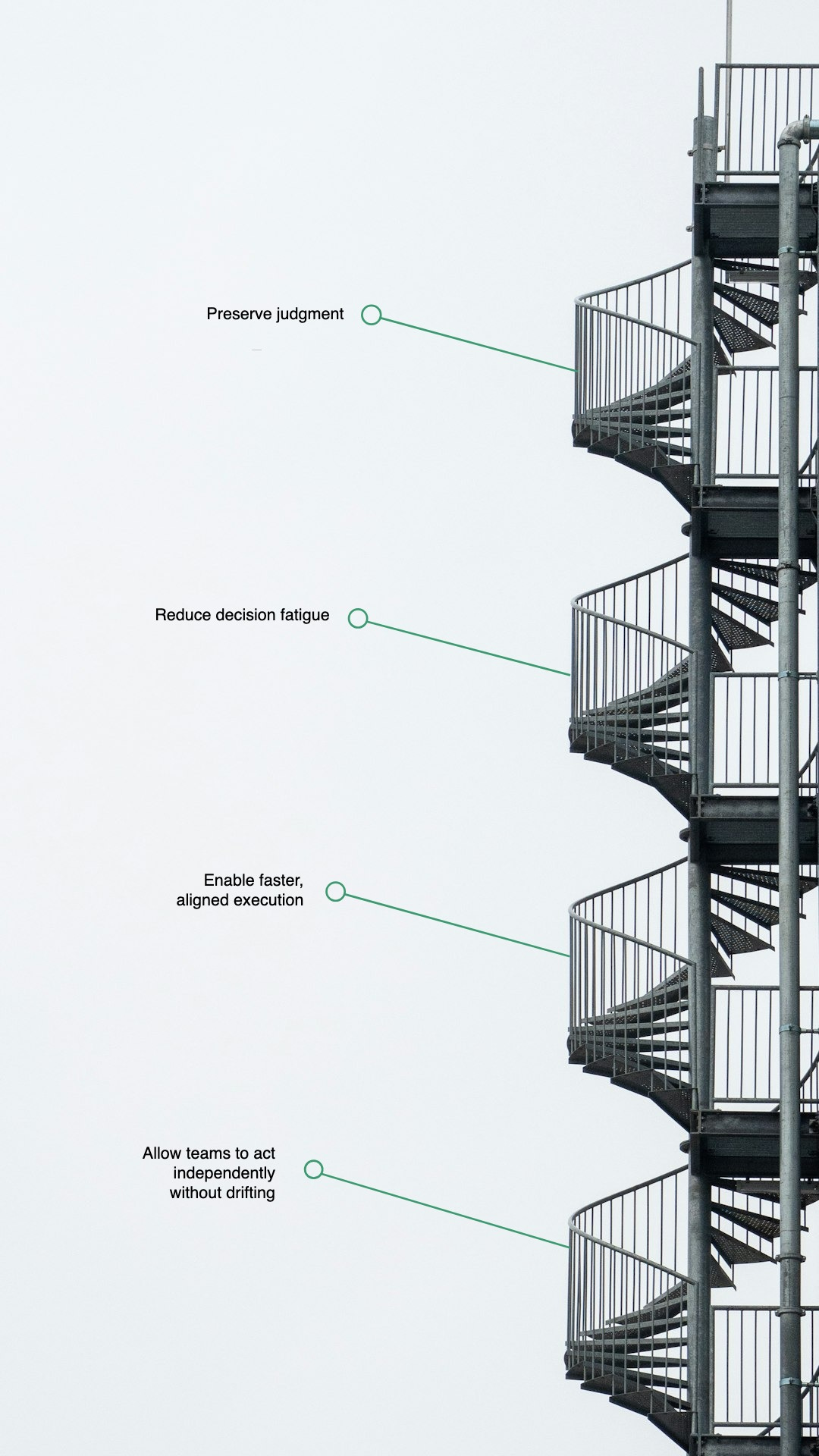
A brand system doesn't remove judgment. It distributes it.
What Systems Reveal About Teams
A system only works if it carries the reasoning forward. Rules without context create hesitation, and guidance without explanation just leads to dependency.
When systems fall short, the symptoms are usually subtle: excessive review cycles, designers seeking reassurance instead of direction, teams avoiding ownership. These patterns often point to leadership gaps more than skill gaps.
Designing for Continuity, Not Perfection
The purpose of a brand system isn't to freeze a brand in time — it's to give it continuity as it evolves. Good systems protect what's essential while allowing change to happen intentionally. They provide structure without becoming brittle, and flexibility without losing coherence.
Designing a brand system is, in a real sense, a leadership act. It prioritizes clarity over control, shared understanding over personal preference, and long-term alignment over short-term convenience.
The strongest systems don't dictate outcomes. They just help people make better decisions, consistently.
Silvia Mejia is a Design Strategy Leader with 15+ years of experience in brand systems, UX/UI, and product design. She has worked with healthcare, energy, B2B industrial, and consumer brands, and creates practical resources for designers who want to work with more clarity and intention.

.png)
Related Content